As part of the HAMLET Virtual Living Lab, Waag proudly presents the winning proposals of its "Trust Me, I’m an AI/rtist" open call. The initiative invited a diverse range of creative practitioners - including artists, choreographers, game designers, and theatre makers - to to critically examine and engage with seven experimental generative AI Enablers.
Participants were invited to challenge these AI tools across several critical dimensions, such as ethics, culture, intelligence, authorship, creativity, labour, bodies, audiences and society. We welcomed proposals that were speculative, critical, poetic, provocative, humorous, performative, constructive or disruptive.
The AI Enablers are being co-developed through a collaboration between technologists and professionals from the gaming, dance, and theatre sectors. Following a competitive process that began with 156 submissions and concluded with a series of jury pitches, four final artistic proposals were selected.
From January to September 2027, these four artists will be working closely with Waag’s HAMLET curating team and the HAMLET’s technology partners, and the collaboration process will lead to a final presentation in the last month. Here is a brief introduction to the proposals, why they are selected, and the artists.
Fiat: The oracle and the ranking
Danae Tapia builds digital oracles. Her project, Fiat, is a machine running a small language model offline on one computer. It answers questions by borrowing from the artist’s own journals and dream records. During Trust Me, I’m an AI/rtist, Tapia will study the technical dynamics of consensual engagement between humans and machines at the moment of artistic creation. For this, she will test Fiat against the Data-Driven Cultural Content Adaptation Enabler developed by CERTH, which answers questions about cultural production with ranked options scored against audience trends. Working with people from different cultural contexts, and using the intimacy of artistic journals as register, she will study what changes when a machine offers an emotional voice instead of a ranked list. The project seeks the moment of transcendental creation through bodily engagement with machines, an approach the artist has developed since 2018 with her Digital Witchcraft initiative.
Jury statement:
This proposal seems not only a fundamental experiment with the enabler, but also aimed at meaningful testing of the ethics of the development of this type of automation. The fact Tapia is a self-taught maker of these and other bots makes it all the more interesting she can work with this specific enabler, not only for her own artistic experiment, but also as an interesting test case for the makers of the enabler at CERTH.
Danae Tapia is a Chilean artist and researcher based in Rotterdam. Since 2018 she has built digital oracles under the name Digital Witchcraft: generative systems that treat computation as material for divination and ritual, written by hand and run on small, local machines. She was a resident at the Rijksakademie in Amsterdam (2022–2024) and a Mozilla Foundation Open Web Fellow. Her work has been exhibited and performed in Europe, Asia and the Americas. She teaches at the Willem de Kooning Academy. Before and alongside her art practice, she spent more than ten years in digital rights and open-source infrastructure.
I'm Not Moving
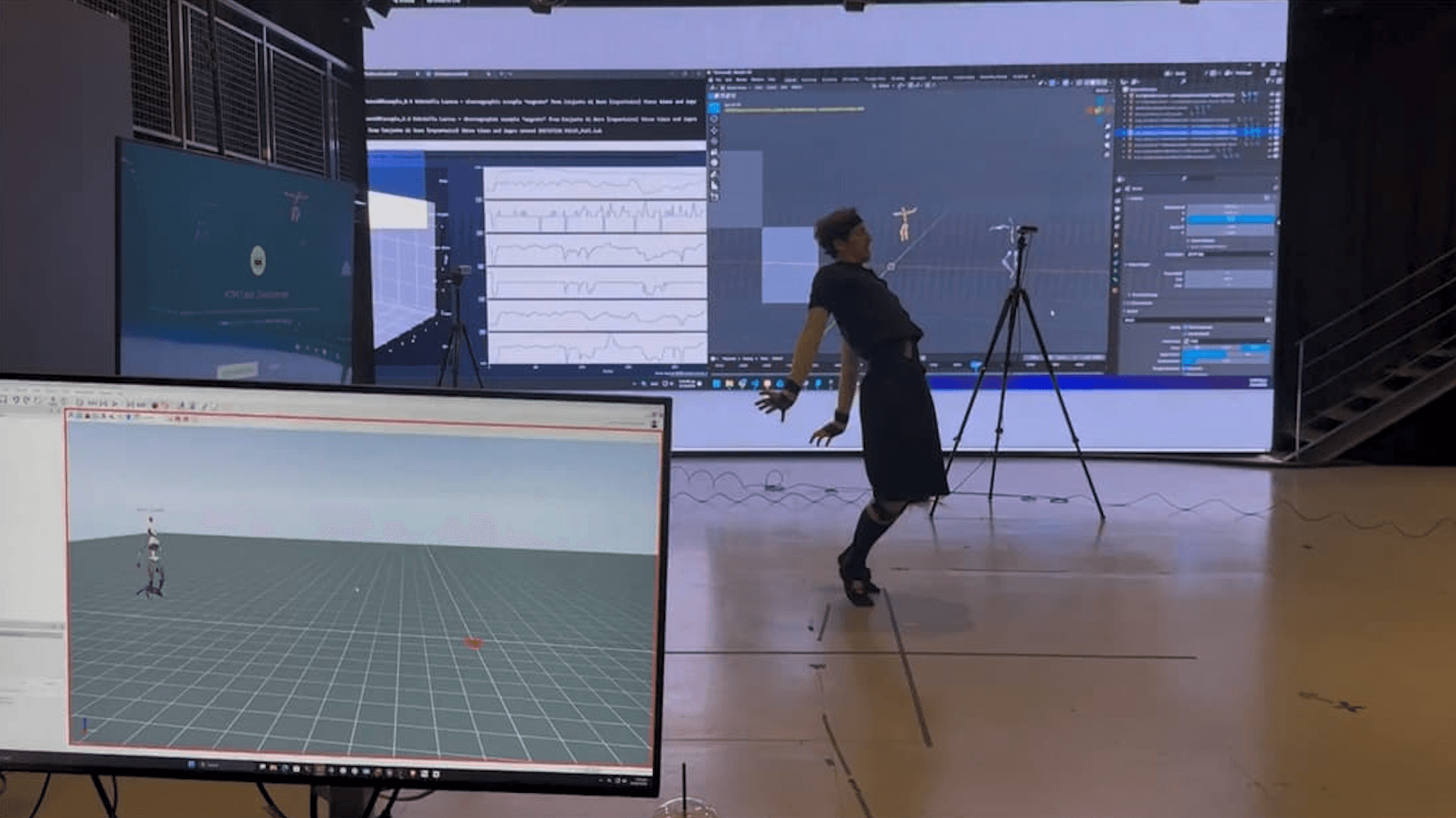
In a hypermodern culture obsessed with datafied patterns, optimisation and frictionless integration, I’m Not Moving looks at what is filtered or smoothed out. Some movement is present in the body yet absent from an AI system’s perception, either going undetected or being read as stillness. The artist calls this unseen movement, and asks whether it is simply an absence of data, or the edge of a model’s ontology. Working with the Dance Style Analysis and Generation Enabler (CYENS) and the Music-to-Movement Translation Enabler (AUTH), the project explores movements too small to register, lost in gaps and glitches, or occurring beneath the skin. What one intelligence, artificial or somatic, cannot see may be perceived by another. The research culminates in a live performance and an open-access counter-archive of unseen movement.
Jury statement:
The proposal thereby has the potential to bring in complementary aspects of movement registration and generation which require critical attention. She questions forces behind the movement, movement that may go as undetected or that may be read as stillness, movements that happen in the interior spaces of the body. By emphazing the distance between the physical body and the system, Ying-Chen critically challenges what the enablers can and cannot do and frames this questioning in artistically and methodically convincing ways.
Ying-Chen Joyce Lin is a Taiwanese intermedia artist based in the Netherlands. Her practice begins from the premise that critical distance from technology is no longer available. Rather than observing systems from outside, she places bodies inside them, her own among them, as data source, interface and disturbance. Drawing on postphenomenology and posthumanism, she treats technology as something that shifts between an extension of the self, a quasi-other and an environment, and understands the body as a perceptual boundary continually renegotiated through this mediation. Working with biosignals, time-based materials and generative systems, she builds environments where human-machine relations expose their friction, imperfection and mutual dependency, proposing this interdependence, rather than individual self-optimization, as a way of living with technology.
PLACEHOLDERS
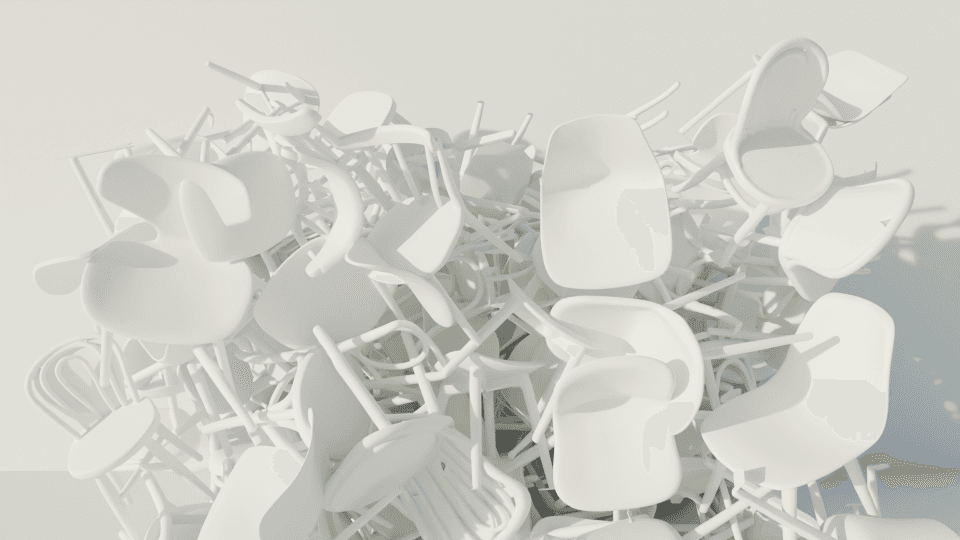
Ask an AI for a chair, again and again, and it might return the same average idea of a chair: new, clean, and predictable. If these tools learn from catalogue-like data, the specific might get lost on the way. PLACEHOLDERS use the Generic Procedural Content Generation Enabler as a landscape of possibilities: a territory of probable shapes. asks how a 3D generative AI perceives common objects: what makes up the average, and what gets left out. The artist Bernat Cuni will generate objects with the Enabler, then go into the field to find the real versions, with their repairs, local materials and lived time. This gives us a delta: a gap, a distance from the ideal to the real. These two actions might already speak for themselves: what is in, what is left out, what is real, where is time, where are the lived experiences. The gap between the two becomes a signal, and workarounds will be explored to bring locality back into generic models.
Jury statement:
Bernat Cuni’s proposal is simple, clear, strong and evocative, exploring the intersection and the contrasts between the physical and the digital, the ideal and the real, the generic and the specific, the universal and the local, centripetal and peripheral forces through critical and creative application of the HAMLET Generic Procedural Content Generation Enabler. His elegantly simple but well thought through approach promises to yield outcomes that are both artistically appealing as well as critically revealing pre-articulated structures of perception embedded in the Enabler development.
Bernat Cuní is an artist and designer based in Barcelona. He started out in 1999 as an industrial designer, but turned away from producing physical goods, which he found extractive and consumerist, towards research-based design focused on people rather than products. Since then, he ran sustainability projects, managed a design incubator, worked with digital fabrication to democratise access to the means of production, took part in several EU research projects and launched a couple of startups.Since 2019 he has focused on his own artistic practice around digital-craftsmanship: experimental, technology-based projects beyond corporate-solutionism. He works with code, crafts and robots to explore the digitisation of objects and spaces, and currently experiments with artificial intelligence, mixed reality and 3D.
'Naphántasto: Antístrofo
Hands sculpt and deconstruct sound through 'Naphántasto, the gesture-controlled instrument designed by Kollias. Different versions of a musical composition take shape in their movements. Music-to-Movement Translation Enabler algorithm carries the music in the other direction, shaping it into gestural performances. The performer imitates those gestures and makes music again. And the cycle moves on and on. 'Naphántasto: Antístrofo plays with these constant inversions. The project investigates imitation, reinterpretation and authenticity by asking what remains of a composition as its different versions pass between sound and gesture. What does the machine keep of a piece of music when it turns it into movement, and what does it throw away? What assumptions guide the translation of music into movement and back to music? When does a piece stop being itself and become something else?
Jury statement:
Through his ambition to provoke the maximum creative potentials from AI, his critical questioning of what may be lost when EA#6 translates music to movement and his ambition to develop new approaches to music composition with new AI technologies, he challenges the enabler development in ways that explore how sound and gesture can inform each other in mutually strengthening ways while at the same time staging this transposition in a real performance. His interest in how this experiment resonates with audiences and users has the potential to enrich the scope of possible artistic output and critical reflection on the creative potentials of the HAMLET enablers through co-creative, collaborative dialogue in meaningful ways.
Dr. Phivos-Angelos Kollias is a Berlin-based composer-music technologist. His projects incorporate cables, sensors, code, microphones, speakers, instruments, and any possible non-living object as interactive media. His music is a dialogue between acoustic aesthetics, classical orchestration, noise sensibility, metal timbres, and electronic idioms; curiosity driven equally by the absurd, the ridiculous, interdisciplinary Complexity theories and artificial intelligence paradigms. Co-founder and artistic lead of Echorroes, a human-centred interactive music and AI initiative (nominated S+T+ARTS prize 2025).