Waag is excited to announce Trust me, I’m an AI/rtist: an open call for creative interventions that result from critical engagements with AI tools. Apply before 30 September, 23:59 CEST!
Trust Me, I’m an AI/rtist invites artists, theatre makers, choreographers, dancers, game designers and other creative practitioners to engage directly with seven experimental generative AI Enablers. These AI tools are currently being co-created with technologists and dance, theatre and gaming professionals. This open call is an invitation to enter the development process of these tools. Selected artists will gain access to the technologies, datasets, interfaces and assumptions that shape these systems while they are still being built.
Rather than testing whether these systems work, artists are invited to ask more difficult questions. Why do these systems work the way they do? For whom are they designed? What forms of creativity do they enable, and what forms do they constrain? What assumptions about culture, intelligence, authorship, labour, bodies, audiences and society are embedded within them? Can artistic practices reveal blind spots, expose hidden biases, question environmental costs, invent unexpected uses or imagine alternative technological futures?
We are looking for individual artists and collectives who are willing to move beyond adoption and into investigation. Participants are invited to challenge, misuse, reimagine, hack, subvert, collaborate with, play with and creatively interrogate these technologies. We welcome proposals that are speculative, critical, poetic, provocative, humorous, performative, constructive or disruptive.
Practical information
Call closes: 30 September 2026, 23:59 CEST
For whom: Artists, designers, creative technologists, theatre makers, dancers, choreographers, and game designers.
Commission fee: €20.000 excluding VAT (including artist fee, travel, accommodation, production costs, etc.). Applicants must have a VAT number in Europe.
Duration: January till September 2027, with final presentations in September 2027
Please use the Application Template and upload your application as PDF.
Download the Guide for Applicants and read through it carefully before you apply. If you have any questions, please contact Zoénie Liwen Deng via zoenie [at] waag [dot] org.
Video registration information session
An information session was organised on 31 July, during which the technology partners presented and demonstrated the seven AI Enablers. The session was followed by a Q&A. You can watch the full recording of the session on our Peertube.
About the AI Enablers
The AI Enablers are currently being developed as part of the Horizon Europe project HAMLET by its technology partners, together with pilots in gaming, performance and theatre across Europe. Engaging with a specific AI Enablers includes visiting the technology partner on site. You can find full descriptions of each AI Enabler in the Guide for Applicants.
The Generic Procedural Content Generation Enabler
Location: The Centre for Research and Technology, Hellas - Greece
This Enabler aims to support the generation of 3D assets & avatars from textual descriptions by making 3D generation faster and more efficient in terms of the computational resources and time required for an asset to be generated.
The Data-Driven Cultural Content Adaptation Enabler
Location: The Centre for Research and Technology, Hellas - Greece
This Enabler is designed to support audience-aware and trend-informed creative content ideation. It processes user intent, expressed through textual input describing a creative goal and optional constraints, and transforms it into a structured collection of candidate content ideas accompanied by evaluation scores and rankings.
Cross-Domain Audience Engagement Analytics Enabler
Location: The Audience Agency, Warrington, the UK.
This Enabler is architected as a horizontal analytics tool that transforms heterogeneous (disperse datasets), cross-domain cultural participation data-such as event records, survey responses, and public trend signals-into governed, interpretable audience engagement trends or as we call them, signals. These signals are used as inputs by chatbots, creative tools, or planners to support human decision-making.
Dance Style Analysis and Generation Enabler
Location: Centre of Excellence for Research & Innovation - Cyprus
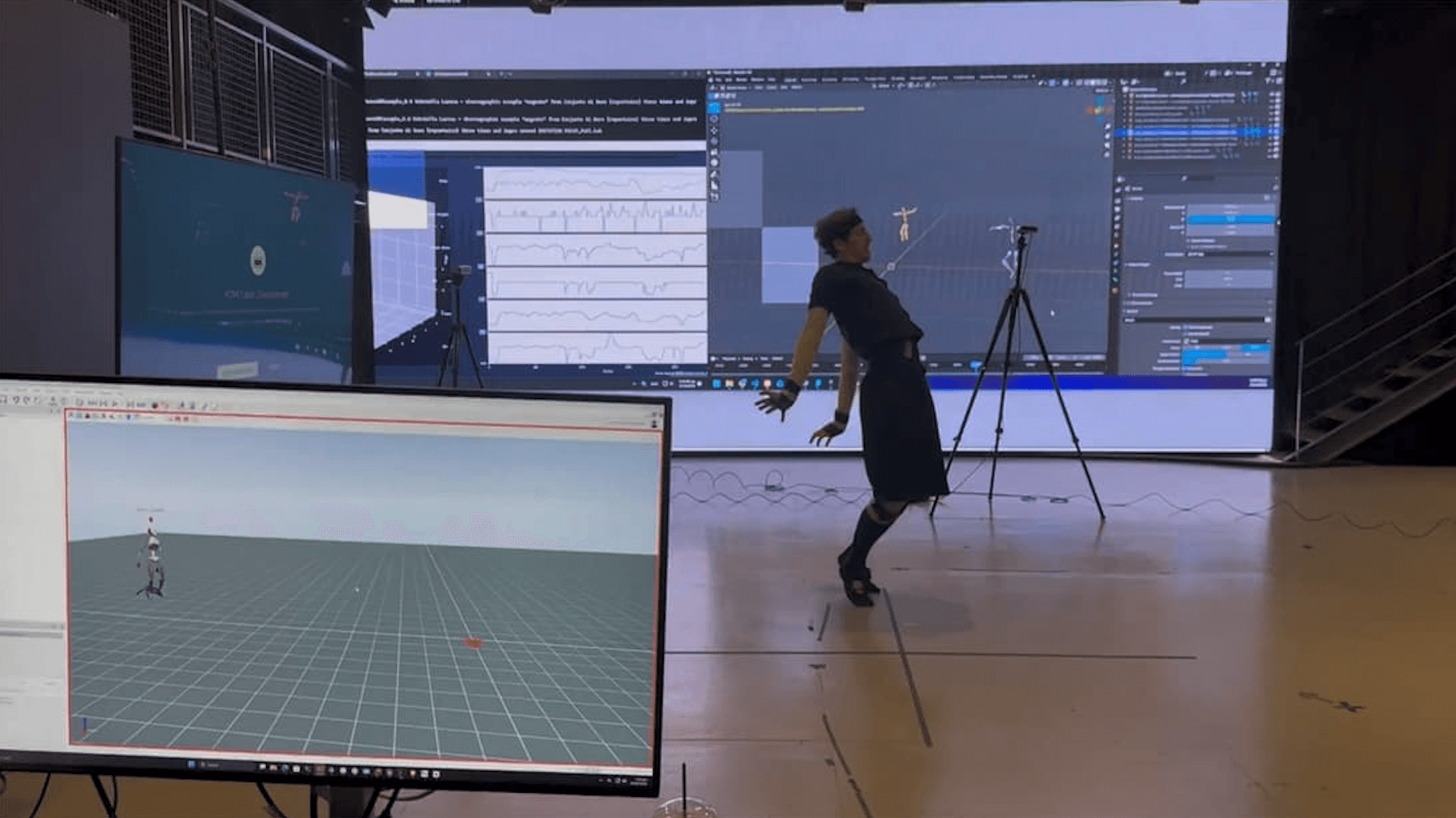
This AI-powered enabler takes as input dance footage (video) and produces a virtual 3D representation of this dance sequence/choreography. Utilizing style-coherent motion analysis algorithms, the enabler will dissect dance movements into BODY, EFFORT, SHAPE, and SPACE components, capturing the essence of each performance.
Immersive Design Integration Enabler for Dance & Theatre
Location: Centre of Excellence for Research & Innovation - Cyprus
This enabler will help creators in dance and theatre experiment with innovative staging and narrative environments, pushing the boundaries of traditional performance spaces by employing (NLP) algorithms to create XR environments with an integrated speech-to-3D Editing system, which will allow users to quickly edit and orchestrate 3D scenes.
Music-to-Movement Translation Enabler
Location: Aristotle University of Thessaloniki - Greece
This Enabler transforms raw audio into a rich, time‑aligned feature set that can be directly consumed by motion‑generation algorithms, spatial‑audio rendering, and visual choreography tools. By unifying genre classification, emotional V‑A analysis, rhythm extraction, and latent‑space projection, it provides a seamless pipeline from sound → movement → spatial audio → visual feedback, enabling integration of music and dance in contemporary performance.
Adaptive Narrative Enabler for Games & Theatre
Location: CAUSA Creation - Austria
This Enabler procedurally creates interactive story scenarios for players to explore on the fly. An evolutionary AI is trained on a database of story elements, interactions and tags, pre-written by creators and evaluated by human or machine. The trained AI is then able to generate infinite variations of stories, based on the database given. It rejects LLMs due to their dependence on copy-righted or public domain corpora-sources that often encode 19th and early 20th-century norms such as sexism, racism, and imperialism.
About HAMLET
The development of the AI Enablers and the open call are part of the European Horizon project HAMLET, which aims to make the benefits of generative AI accessible to organisations of all sizes in order to promote a sustainable digital transition. Read more about the project.