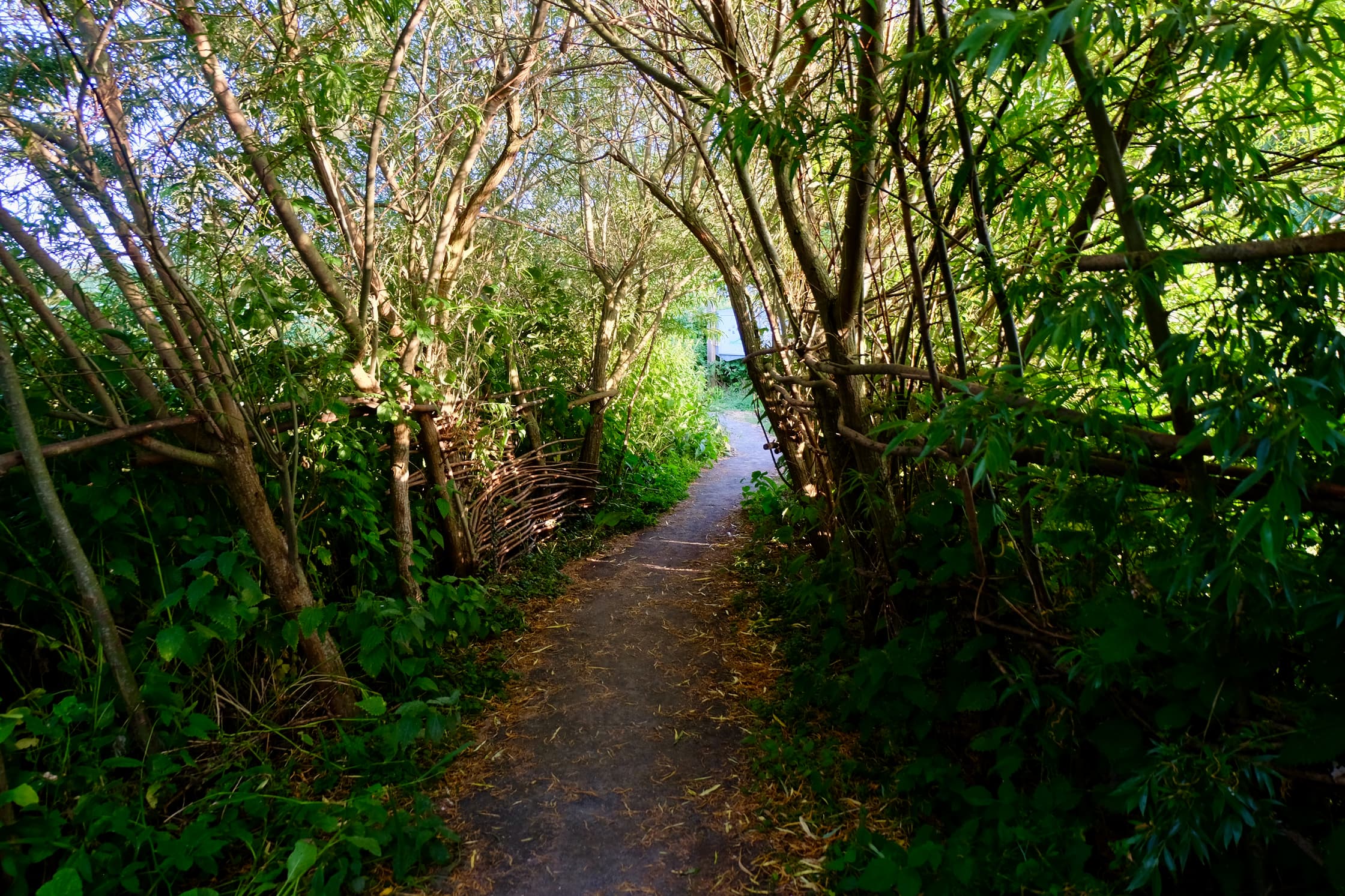
Det Digit was one of the first digital artists in the Netherlands, working from a house in the woods near Knegsel, twenty minutes from one of Europe's largest technology manufacturing regions. Her last wish was that the house become a residency. Since 2024 it has been that: a place where artists and researchers live and work for a defined period at the intersection of art, design and science.
"The house is still shaped by her," says Werner van der Zwan, one of the resident artists. "The garden is divided into time zones. So is the library. It is a world that is isolated and connected at once, built by someone who was thinking about avatars and networked identity before most people had been online."
This summer, in a residency run by Det Digit Art House together with Waag Futurelab, two artists spent a month there. Anna Musikhina built a device that harvests energy from the radio signals already in the air. Werner van der Zwan built a wooden arm driven by the electrical activity of a mushroom he found in the garden. They had a lot of challenges during the process - signals were so faint that they took minutes to register or energy was so small that it had to accumulate before anything happens.
We talked to the two artists in residence to learn about their experiences and challanges:
Anna Musikhina
How did you arrive at the idea you worked on at Det Digit Art House, and how much did it change once you were actually there?
One of the aims of my practice this year has been to explore digital infrastructure. When I found this opportunity I realised straight away that it could extend an interest I already had: how radio frequencies affect nature, and how other species experience these relatively new shared habitats full of human-made RF infrastructure.
At the residency the idea became more site-specific. Being in the forest made me think about how these invisible infrastructures move through an environment we tend to perceive as natural, and what it means to share a space with technologies we cannot directly sense.
The house sits in the woods at Knegsel, close to one of Europe's largest technology manufacturing regions. Did that setting feed into the work, and if so, how?
Definitely. There was a striking contrast between being in the forest and being so close to ASML, sometimes hearing aeroplanes alongside the birdsong. It emphasised how entangled nature and technological infrastructure are. That contrast also framed the research. I was thinking a lot about invisibility: how something this vast can be all around us and still go almost unnoticed, and how I could make it perceptible and find ways of working with it.
The residency asked artists to work with regenerative principles like permacomputing and degrowth. What did that mean in practice for you?
I was working with a rather unconventional renewable source: harvesting ambient RF from Wi-Fi, mobile communication and other radio signals. Using basic electronics to build the harvesting modules, I could only collect an extremely small amount of electricity. But that was the beauty of it. In line with degrowth and permacomputing, I had to work with what was already available in the air around me at Det Digit Art House, wait for the energy to accumulate, and design for very slow processes. There is a nice paradox in it too, because the process was completely self-reliant. The energy harvested from the environment ended up powering the system itself.
What was the most difficult part of the process?
The energy was tiny and unpredictable, and a circuit would sometimes behave completely differently than I expected. In a way that didn't interfere with the research. I was looking for a response from the environment and I got one, with a very low-tech module.
What stayed with me more was reading about the possible environmental effects of RF: its influence on bee behaviour, on birds' orientation, the physiological responses observed in plants and trees. There is something unsettling about how little energy I could harvest, and how little I could reduce the RF presence, when the infrastructure producing these signals is so extensive and potentially affecting so many other species. It made me feel the problem is much bigger than my device, and that we need to talk about these effects far more.
Looking back at the month as a whole: what did the residency give you, and what would you want a future resident to have that you didn't?
Time to stay with one question and experiment without having to know the outcome. It pushed me to think about RF infrastructure ecologically: how we might co-design it with other species in mind, or reduce its presence in ecologically sensitive areas. I plan to continue this research.
For a future resident I would want more access to technical knowledge and equipment, particularly for measuring very weak RF signals. That would let the technical side of the research go further.
Werner van der Zwan
How did you arrive at the idea you worked on at Det Digit Art House, and how much did it change once you were actually there?
I was already working on wooden prosthetics, recreating body parts. My work usually has something theatrical in it, a dramaturgy, a kind of entropy: self-consuming sculptures where electrical activity produces the movement.
I started with the hand. Then I found a mushroom in the garden and tried to revive it, but the weather was dry and it didn't work. I built a microcontroller to log the data. I didn't want to use scientific equipment, I wanted to make my own thing, and I thought I was measuring biological activity. It certainly looked biological. Very low noise. I tested it with agar and calcium. What struck me was how incredibly slow the signals are. A small pulse once every four or five minutes.
The house sits in the woods at Knegsel, close to one of Europe's largest technology manufacturing regions. Did that setting feed into the work, and if so, how?
It was strange to cycle to ASML and see all those buildings. A funny combination: villagers, big companies, big data. I was mostly inside, in a very organic setting, cooking with local produce. It was good to be somewhere so quiet, in the forest, with just some animals around. For someone who lives in a city that is a big change. It creates an openness that quiets you down.
The residency asked artists to work with regenerative principles like permacomputing and degrowth. What did that mean in practice for you?
There is a kind of information processing that happens in mycelium, and you can use it in sensor processing, for instance as a response to pressure. There is a specific mushroom I work with, and you can more or less program a memory into a shiitake. That was my starting point for thinking about mycelium as something with memory. What I actually wanted to do needed much more time than I had.
Sometimes it felt like it was responding to me. It was so small that it seemed like nothing was happening at all. That gave me a sense of something alien, and made me think about my way of inhabiting the world next to its way of inhabiting it. One of the highlights was patience, understanding that some things simply take time. A fungal roommate.
What was the most difficult part of the process?
Finding a form that fits the material. And the technical problems: how to measure precisely, how to distinguish the spikes from everything else going on. I got help from a friend who works in computational neuroscience, and with him I could work it out.
Looking back at the month as a whole: what did the residency give you, and what would you want a future resident to have that you didn't?
It is a very special place. There is no pressure. You are there, focused on your project. It gave some air to my practice and my ideas, that atmosphere and stillness and space. It took the pressure off. It was also good to talk to the villagers there.
What would have helped is more room to discuss the ideas, maybe a mentor. When someone asks you a question like "why the hand?", you get the chance to think it through again from another perspective.