As the digital realm weaves itself into the fabric of our societies, we are compelled to reflect on what this means for our democracies.
European Digital Deal is a three-year investigation co-funded by Creative Europe into how the accelerated, yet at times unconsidered adoption of new technologies – such as artificial intelligence, machine learning, blockchain and algorithmic processing – can alter or undermine democratic processes.
Through a myriad of programmes running from January 2023 to December 2025, we want to set up a new kind of public forum where cultural institutions, artists, researchers, educators gather to reflect on what a deal that safeguards democratic values in the digital realm might look like, and the role they can play in shaping it.
Waag's focus
In Digital Deal, Waag Futurelab questions the role of artificial intelligence in relation to working conditions in (greenhouse) horticulture. Until now, AI robots were thought to replace human labour. But could AI robots also be used in improving working conditions? Where the primary goal of technology is not to improve efficiency, but to contribute to other values such as well-being, safety and enjoyment?
Waag not only exposes current risks, but we also question the current architecture of innovation processes. For instance, we want to make a case for the long-term consequences for the environment and society. These must be taken into account when designing fair, ethical and sustainable technologies for the future.
Artist residencies: Imagining Robots
As part of Digital Deal, Waag invited two artists to the Imagining Robots residency: Penelope Cain and Špela Petrič. During their residency they will develop new imaginations of AI robots in greenhouse farming.
Špela Petrič - The Archive of In-Operables
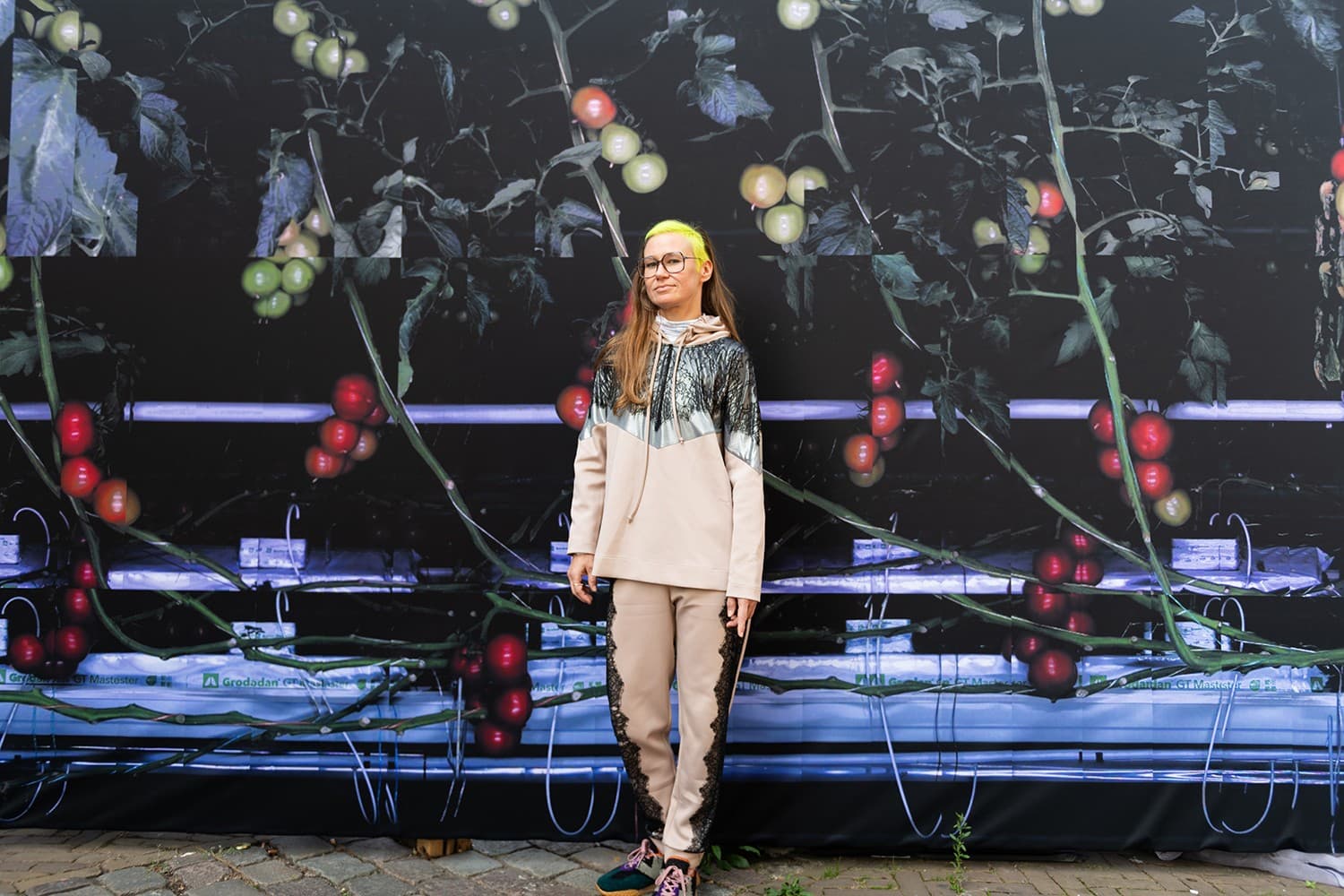
Artist Špela Petrič wanted to look behind the walls of the tomato greenhouse to see what a tomato’s life is like before we consume it. The Archive of In-Operables is the result of her research into robots in greenhouse horticulture.
Within Špela Petrič's year-long EU Digital Deal residency, Stichting Tomatoworld, a field lab for data-driven autonomous cultivation and robotics, hosted an intense one-week artistic research workshop inside their greenhouse. Petrič invited five peers — a philosopher, a choreographer, a writer, a performer and a filmmaker — to stay alongside the tomatoes, bumblebees, and workers, and explore what she names "awkward intimacies" with the vegetable production facility. They examined their relationship to these spaces as consumers welcomed into the belly of industrial agriculture, a reality to which they are usually oblivious. Through collective experimentation they devised and performed a series of choreographies that spoke to worker solidarity, family memories tied to agriculture, being surveilled, carework, play, and isolation.
During the week, greenhouse sensors (multispectral, thermal, surveillance and timelapse cameras) captured the actions. A year later, the participants were interviewed about the experience. The video documents their reflections and the artistic experiments carried out inside the greenhouse.
CREDITS:
Archive of In-Operables: Tomatoworlds Residency | Dates: February 17-22, 2025 | Collaborators: Áron Birtalan, Rob van Pelt, Antonia Steffens, Reon Cordova, Angieszka Wołodźko | Host: Tomatoworld | With special thanks to: Aart van den Bos, Nico Ammerlaan, Jan Enthoven, Karin Plaisier, Joyce van Dalen-Zwinkels, workers at Tomatoworld, and Andreas Hofland. Thank you to Gerrit Polder from Wageningen University and Research for lending us the multispectral cameras | This work was realised within the framework of the European Digital Deal residency program at Waag Futurelab with support from the Creative Europe Culture Programme of the European Union.
Penelope Cain - Speaking in Chitin Tongues (The Translator)
During the exhibition ‘Bits and Bots’ in Zaragoza (ES), artist Penelope Cain presented the work ‘Speaking in Chitin Tongues’, consisting of an installation featuring a 9-minute video. You can see excerpts from the video and documentation of her installation in the video above.

"What is post-human care?" Cain asks.
Pivoting from the short story by writer Ursula K. Le Guin, 'The Author of the Acacia Seeds', and its playful imagining of a distant future when humans can speak with all animals on the planet, and soon, with plants.
'Speaking in Chitin Tongues' imagines a care based relationship between an autonomous robot and the vegetable plants it is programmed to care for. Touching on a series of themes including labour and the financial edges of care, vegetal modes of sensing and worlding, and lossless nature of robotic memory.
This video documentation of the original multiscreen robotic performance, shows a small insectoid robot recalling the time it was in a contractual economic partnership with a group of vegetable plants. A partnership that ended poorly when the economic circumstances changed.
In its dream-like video recollection, narrating plant husbandry specifics and economic considerations - interspersed with poetic asides - the robot re-narrates this singular memory through a series of iterative retellings (that it is unable to forget).
Meta data
Project duration
Team
Financiers
This project has been co-funded by the European Union’s Creative Europe programme under grant agreement No 101100036. Views and opinions expressed on this page are those of the author(s) only and do not necessarily reflect those of the European Union or the European Education and Culture Executive Agency (EACEA). Neither the European Union nor the European Education and Culture Executive Agency (EACEA) can be held responsible for them.